 Français
Where the network reaches, and where it stops
Moroccan mobile coverage reads better by terrain than by administrative map. Here is how it behaves depending on where you are standing.
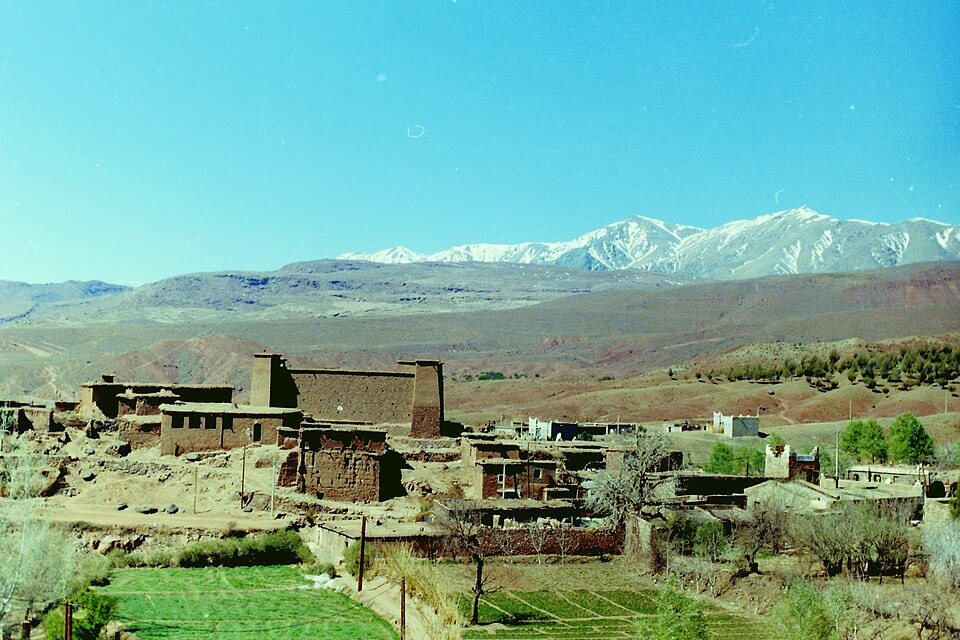
Photo : Dupont66, CC BY 4.0, via Wikimedia Commons

By terrain
Four situations, four network behaviours

Cities and urban areas
Casablanca, Rabat, Marrakech, Tangier, Fez, Agadir: continuous mobile service, comfortable data, decent indoor coverage in most buildings. This is also where 5G deployment is progressing, with availability varying by district and by operator.
What to do
Nothing special to prepare. This is the right place to activate an eSIM or download your offline maps.

National roads and motorways
The main corridors between cities are followed by the network. On the coastal motorway and the main national roads, gaps are short and localised, typically in cuttings and tunnels.
What to do
Start navigation before you set off rather than en route, so you are not depending on signal at the moment it recalculates.

High Atlas valleys
Terrain decides everything. Signal usually reaches the villages and the inhabited valley floor, then vanishes as soon as you climb a slope or cross a secondary pass. Two points two kilometres apart can be in opposite situations.
What to do
Tell someone your route and your expected return time. Do not count on placing a call from a pass.

Tracks, plateaus and desert
On the southern tracks and towards the erg, having no network is the normal state, sometimes for hours of driving. Camps and staging villages often have a connection point, but the link stays slow and intermittent.
What to do
Offline maps are not optional. Calculate water and fuel without assuming you can call for help.
eSIM
eSIM changes nothing about coverage
An eSIM is a way of activating a line, not a way of improving the network. It uses the same masts as the physical card from the same operator. Its real value lies elsewhere: activation before arrival, keeping your original line on the second slot, and no fiddling with a micro card in an airport hall.
- Activate the eSIM on a stable connection, before you leave the city.
- Keep your original line active for verification codes sent by SMS.
- A physical SIM bought at the counter remains the simplest fallback.

Do this while you still have signal
- Download your route area in your maps app for offline use.
- Save your accommodation address as plain text, not only as a link.
- Write your Moroccan number and one local contact number on paper.
- Tell someone your planned route and return time.
A particular valley or track in mind?
Send us the route. If we have something verifiable, we will tell you; if we do not, we will say so plainly.