 Français
Staying reachable in the Atlas and towards the desert
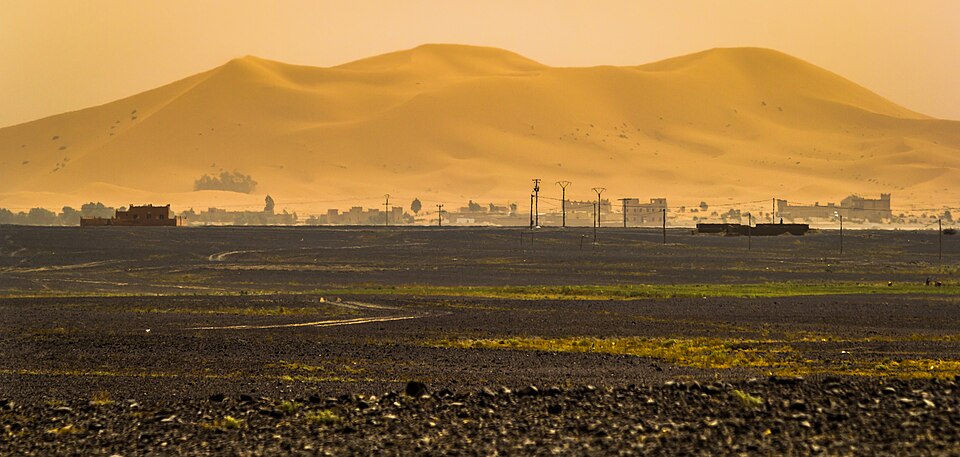
Photo : Ayman Abdelilah, CC BY-SA 4.0, via Wikimedia Commons

Off the main corridors, having no signal is not an incident: it is the normal state. You prepare for it before leaving.
Along the coastal corridor, coverage is not a question. It becomes one as soon as the road climbs towards a High Atlas pass or drops onto the southern plateaus. There, signal turns into an intermittent resource, and the only useful moment to organise yourself is while you still have it.
How terrain carves up the coverage
Masts serve villages and inhabited valleys. Between two valleys, a single slope is enough to cut the link. The practical consequence is counterintuitive: you can have signal in an isolated village, then nothing for an hour of driving, then signal again at the next village.
On the southern tracks and towards the erg, the scale changes. No network becomes the default state across long distances, and the points where it returns are countable: a staging village, a camp, a busy junction.
What to prepare while you still have signal
The important part happens the evening before, in town, on a stable connection. This list takes a few minutes and replaces most expensive solutions.
- Download your whole route area in your maps app for offline use, margins included.
- Copy your accommodation addresses and numbers into a local note, as plain text rather than a link.
- Write on paper your Moroccan number, a local contact and someone back home.
- Send your route and expected return time to someone who would notice your silence.
Saving the battery, which becomes the real constraint
A phone hunting for an absent network drains its battery far faster than in normal use. On a long stretch without coverage, aeroplane mode solves that in one move, and your offline maps keep working with GPS. Switch the radio back on at the points where signal returns, long enough to send a message.
A charged power bank and a spare cable weigh little and change everything on a multi-day route. Sockets exist in the accommodation, but the days are spent far from them.
When a phone is no longer enough
For a self-supported trek in the High Atlas or a crossing by track, the phone stops being the right safety tool. Mountain guides and agencies work with communication equipment suited to those areas. Going through them is not only a matter of comfort: it is what allows an alert to be raised from a place no mast reaches.
The habit that costs nothing
Tell someone. A message sent at the last point of signal, saying where you are going and when you expect to be out, needs no equipment and turns an unexplained disappearance into a known deadline. It is the single most effective measure on this page.